

Description: Identified key drivers of term deposit conversion (including call duration, channel, and engagement patterns) to inform strategies that improve campaign efficiency and conversion rates.
Project Links: Github Repository
Executive Summary
The bank’s telemarketing campaigns convert at 11.27% (4,639 / 41,176 contacts), with performance concentrated in a small number of engagement conditions.
Conversion is primarily driven by engagement intensity and history rather than customer demographics. Outcomes vary sharply by:
- Call duration: Conversion rates increase from 0.81% to 48.61% as the duration goes up
- Channel: Cellular is the more effective channel with a conversion rate of 14.74%, compared to landline calls (5.21%)
- Prior outreach: Clients who previously subscribed are dramatically more likely to convert again (65.11%)
- Number of calls: Efficiency declines with repeated outreach, with conversion dropping from 13.04% on first contact to 6.14% after 5+ attempts
Overall, campaign performance is constrained less by who is contacted and more by how, when, and how often engagement is executed.
Problem Statement
The bank conducts large-scale outbound campaigns to promote term deposits but lacks clarity on what drives conversion efficiency. Key gaps:
- Which customers are most likely to convert?
- Which campaign strategies are effective?
- Where is effort being wasted?
This limits their ability to optimize targeting, improve efficiency, and increase return on outreach efforts.
Diagnostic Questions
The analysis was guided by the following diagnostic questions:
- How many total contacts were made, and what percentage resulted in a subscription?
- What are the conversion rates by job, marital status, and education? Which customer groups show higher or lower likelihood of subscribing?
- How does debt (loan status and default) affect conversion rates? Do clients with active or defaulted loans convert differently compared to those without debt?
- Which contact channel (cellular vs telephone) is more effective for conversion?
- How do conversion rates vary by month and day of the week? Are certain periods more effective, and how reliable are these patterns given campaign volume?
- How do outcomes from previous campaigns (success, failure, non-existent) affect current conversion rates?
- How does the duration of the last call relate to conversion outcomes? Is there a threshold where longer calls significantly improve conversion likelihood?
- How many calls does it take to convert a customer?
- Based on the findings from the analysis, what three strategic actions should the bank implement to improve term deposit conversion rates?
Methodology
- Cleaned and validated 41,176 campaign records (removed duplicates, standardized categorical fields)
- Performed exploratory segmentation analysis across:
- Customer demographics: Campaign execution variables (channel, duration, contact frequency), Temporal patterns (month, weekday)
- Historical engagement outcomes
- Engineered behavioral features:
- Call durations
- Contact frequency tiers
- Loan status grouping
- Computed conversion rates across segments to identify performance differentials
Key Findings
1. Execution variables dominate conversion outcomes
Conversion increases from 0.81% (≤100s calls) to 48.61% (600s+), indicating that engagement depth is a primary driver of conversion.
Channel choice amplifies this effect:
- Telephone: 5.21%
- Cellular: 14.74%
2. Prior engagement is the strongest predictor of conversion
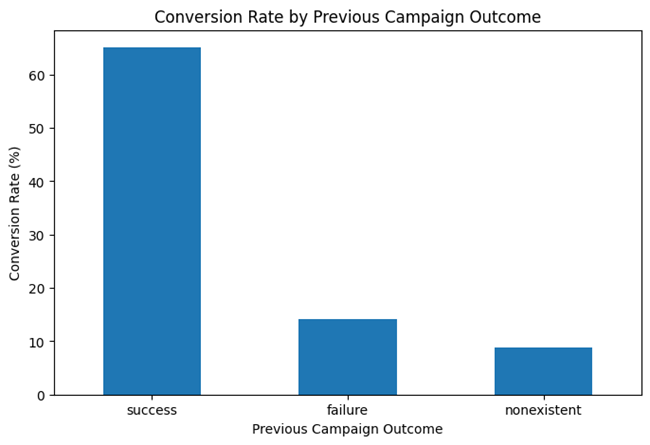
Clients who previously subscribed are dramatically more likely to convert again (65.11%). This reflects the power of positive past engagement and trust built during earlier campaigns.
Even after a failed prior campaign, conversion remains possible (14.23%), though at a much lower rate than success.
Cold contacts are hardest to convert (8.83%), underscoring the challenge of first‑time outreach.
3. Additional contact attempts reduce efficiency
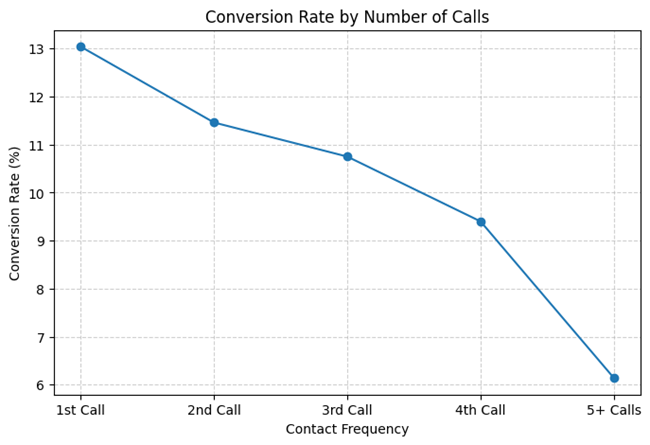
Conversion declines steadily with repeated outreach. Incremental follow-ups show diminishing returns and declining efficiency per contact.
Customer demographics have secondary impact
Demographics influence conversion but are less predictive than engagement behavior. That said, conversion is strongest among students(31,43%), retirees (25.6%), singles, and higher‑educated clients. Blue‑collar (6.90%) and basic‑educated groups are least likely to subscribe, highlighting clear demographic segments for targeting.
Contacts without loans show slightly higher conversion rates (11.34%) compared to those with loans (10.98%). Among loan holders, those with active loans actually show a modestly higher conversion rate (12.54%) than the overall loan group.
Recommendations
- Focus outbound effort on previously engaged customers, particularly those with prior positive response (65.11% conversion rate). They’re likely to result in higher yield per contact, reducing wasted outreach on low-probability segments.
- Reallocate effort toward engagement quality (not volume). Calls lasting at least 3-5 minutes are more likely to increase conversion efficiency without increasing contact volume.
- Focus on quality first calls and perhaps one follow-up to prevent diminishing returns while improving cost per conversion
Tools
Python (Pandas, NumPy), Matplotlib, Seaborn